
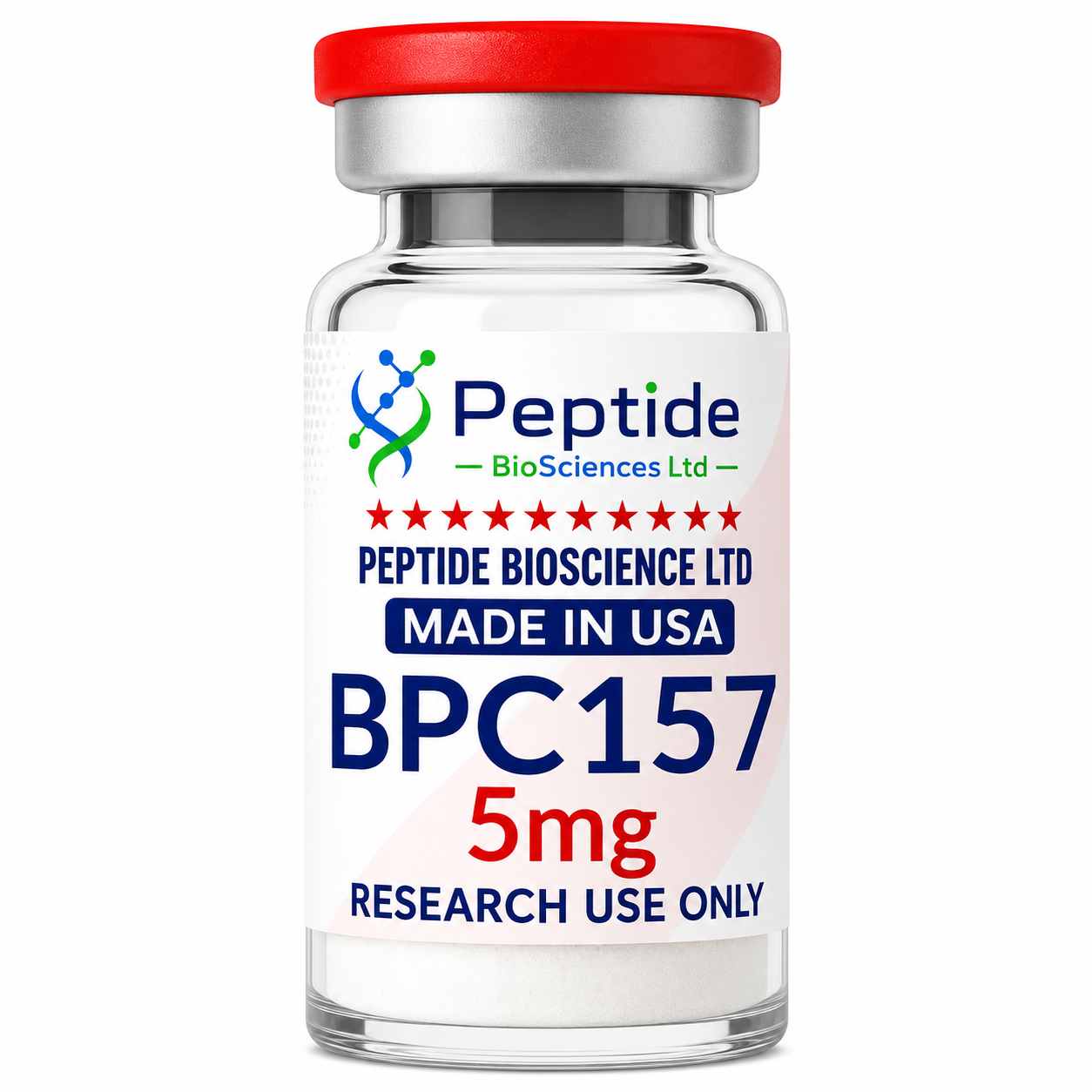
BPC-157 5mg
Original price was: $35.99.$26.99Current price is: $26.99.
- Body Protection Compound-157 — 15-amino acid synthetic pentadecapeptide (Gly-Glu-Pro-Pro-Pro-Gly-Lys-Pro-Ala-Asp-Asp-Ala-Gly-Leu-Val)
- One of the most studied research peptides — over 100 published preclinical papers
- Third-party lab tested · CAS 137525-51-0
- For in vitro research only
BPC-157 5mg — Body Protection Compound
Isolated from human gastric juice, studied in over 100 preclinical papers, and detected in biological samples up to 4 days post-administration (He et al., Frontiers in Pharmacology, 2022) — BPC-157 is a 15-amino-acid pentadecapeptide that has been examined across an unusually broad range of experimental systems. Tendons. Ligaments. Muscle. Bone. Gastric mucosa. Intestinal anastomoses. Blood vessels. Neurons. Most research peptides are studied in one or two tissue types. BPC-157 has been studied in nearly all of them.
Specifications
| Sequence | Gly-Glu-Pro-Pro-Pro-Gly-Lys-Pro-Ala-Asp-Asp-Ala-Gly-Leu-Val |
| One-Letter Code | GEPPPGKPADDAGLV |
| Molecular Formula | C62H98N16O22 |
| Molecular Weight | 1419.53 g/mol |
| CAS Number | 137525-51-0 |
| PubChem CID | 108101 |
| Form | Lyophilized powder |
| Quantity | 5mg per vial |
Connective tissue research
Chang et al. documented tendon outgrowth, cell survival, and migration linked to F-actin formation and FAK-paxillin pathway activation in tendon fibroblast cultures (J Applied Physiology, 2011; PubMed 21030672).
Gastrointestinal research
This is where BPC-157 was first characterized. Sikiric et al. coined the “stable gastric pentadecapeptide” label after documenting cytoprotective properties across gastric lesion, IBD, and intestinal anastomosis models (Curr Pharm Design, 2018; PubMed 29998800).
Nitric oxide pathways
Research has examined BPC-157 5mg in the context of VEGFR2-Akt-eNOS signaling and experimental angiogenesis. Huang et al. documented ERK1/2 phosphorylation and downstream transcription factor activation in vascular models (Drug Design, Development and Therapy, 2015; DOI 10.2147/DDDT.S82030).
Neuroprotective research
Vukojevic et al. reviewed BPC-157 interactions within CNS experimental models including traumatic brain injury systems (Neural Regeneration Research, 2022; PubMed 34380872).
BPC-157 vs TB-500
Both appear in tissue recovery protocols, but the mechanisms are distinct. BPC-157 5mg: GI integrity, connective tissue, NO pathway modulation. TB-500: actin regulation, cell migration, cardiac tissue, blood vessel formation. Complementary, not redundant. Available individually or as a BPC-TB blend.
BPC-157 5mg is Frequently paired with
- TB-500 5mg — Available as BPC-TB Blend.
- GHK-Cu 50mg — Available in Glow 50/10/10.
- LL-37 5mg — Immune pathway research.
Quality and testing
Every batch is independently tested with mass spectrometry identity confirmation. Lyophilized in the United States. Pure peptide — no mannitol, no bulking agents, no excipients. Batch-specific COAs available.
Storage
- Lyophilized: -20°C
- Reconstituted: 2-8°C, use within 30 days
- Protection: Shield from light and moisture; avoid freeze-thaw cycles
References
- Chang CH, et al. J Applied Physiology. 2011;110(3):774-780. PubMed 21030672
- Seiwerth S, et al. Curr Pharm Design. 2018;24(18):1972-1989. PubMed 29998800
- Sikiric P, et al. Curr Pharm Design. 2014;20(7):1126-1135. PubMed 23755727
- Vukojevic J, et al. Neural Regen Res. 2022;17(3):482-487. PubMed 34380872
- Huang T, et al. Drug Design Dev Ther. 2015. DOI 10.2147/DDDT.S82030
- He L, et al. Front Pharmacol. 2022;13:1026182.
FAQ
What is BPC-157?
A 15-amino-acid synthetic peptide originally identified from human gastric juice. Over 100 preclinical studies across connective tissue, GI, vascular, and neurological models.
BPC-157 vs TB-500?
Different mechanisms. BPC-157 5mg: gastrointestinal integrity, connective tissue, nitric oxide pathways. TB-500: actin dynamics, cell migration, cardiac tissue. Complementary, not interchangeable.
Is BPC-157 approved for human use?
No. It is a research compound not evaluated or approved by the FDA. Peptide Bio Sciences LTD products are strictly for laboratory research.
For laboratory research use only. Not for human or veterinary use. Not a drug, food, or cosmetic.
Be the first to review “BPC-157 5mg”
Related products
Reviews
There are no reviews yet.