
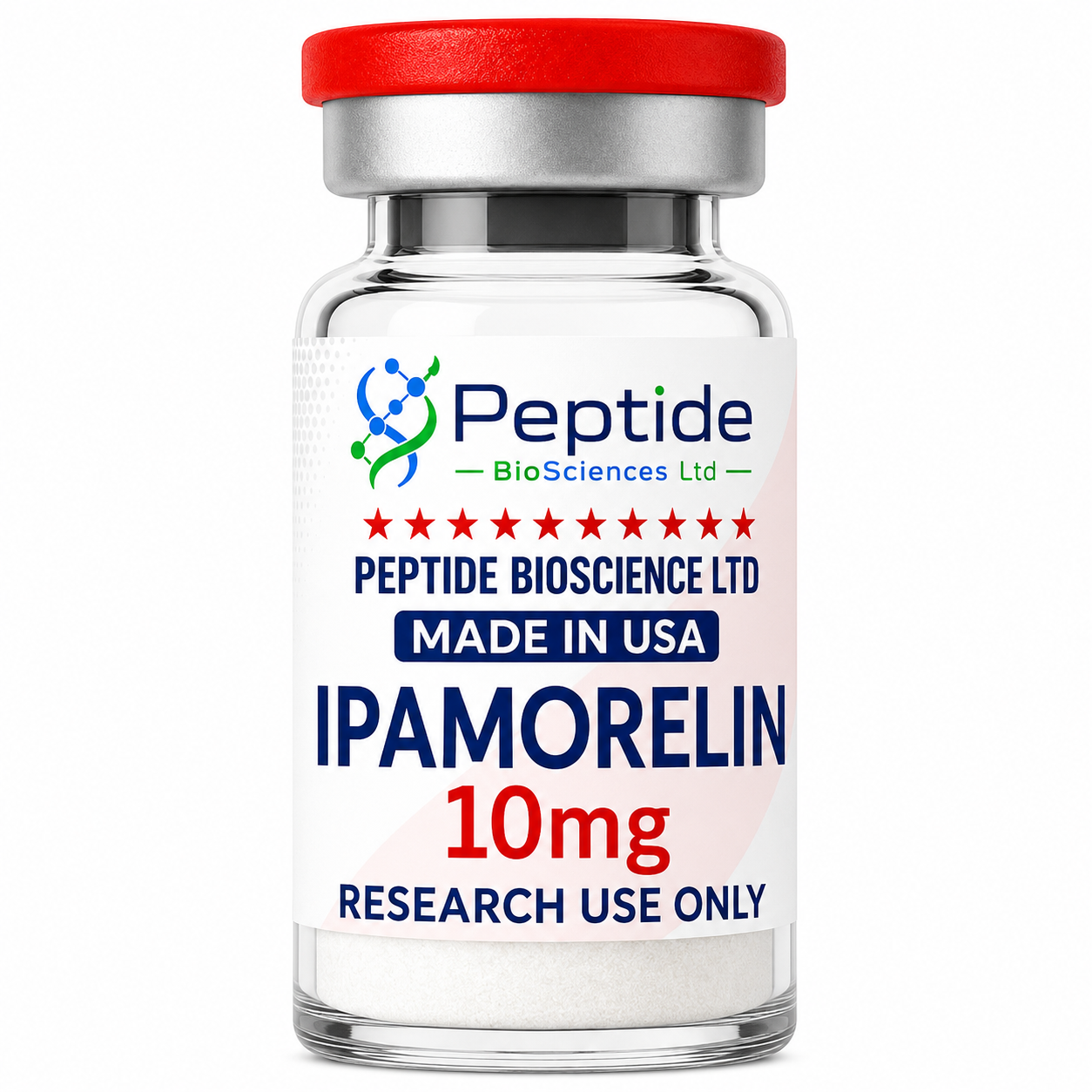
Ipamorelin 10mg
Original price was: $56.99.$39.99Current price is: $39.99.
- Selective GHS-R (ghrelin receptor) agonist — synthetic pentapeptide (Aib-His-D-2-Nal-D-Phe-Lys-NH₂)
- First GHRP-receptor agonist with selectivity comparable to GHRH in published research
- Third-party lab tested · CAS 170851-70-4
- For in vitro GH secretagogue research only
Ipamorelin 10mg — Selective GH Secretagogue
When Raun et al. characterized Ipamorelin in 1998, they called it “the first growth hormone secretagogue receptor agonist with a selectivity for GH release similar to that displayed by GHRH” (European Journal of Endocrinology; PubMed 9849822). That selectivity is what defines this compound. Earlier GH-releasing peptides like GHRP-6 and GHRP-2 stimulated growth hormone but also pushed cortisol and prolactin levels higher. Ipamorelin does not — at GH-releasing concentrations in preclinical models, cortisol and prolactin remain at baseline levels.
Ipamorelin 10mg Specifications
| Sequence | Aib-His-D-2-Nal-D-Phe-Lys-NH₂ |
| Molecular Formula | C38H49N9O5 |
| Molecular Weight | 711.85 g/mol |
| CAS Number | 170851-70-4 |
| PubChem CID | 9831659 |
| Purity | ≥99% (HPLC) |
| Form | Lyophilized powder |
| Quantity | 10mg per vial |
Pharmacology and Receptor Signaling
Ipamorelin binds to the growth hormone secretagogue receptor type 1a (GHS-R1a), a G protein-coupled receptor expressed primarily in anterior pituitary somatotrophs. The binding triggers a phospholipase C-mediated signaling cascade: IP3/DAG release, intracellular calcium mobilization, and protein kinase C (PKC) activation, culminating in growth hormone exocytosis. EC50 has been measured at 1.3 nmol/L in rat pituitary cell assays, with peak GH response occurring at approximately 40 minutes post-administration and a circulating half-life of approximately 2 hours (Gobburu et al., Pharmaceutical Research, 1999).
What distinguishes ipamorelin from earlier GHS-R agonists (hexarelin, GHRP-6, GHRP-2) is its signaling selectivity. While those compounds activate GHS-R1a and also engage other pathways that elevate cortisol and prolactin, ipamorelin produces minimal cross-reactivity at GH-releasing concentrations. This selectivity makes it a valuable tool for researchers studying isolated GHS-R1a-mediated somatotroph activation without confounding adrenocorticotropic or lactotropic effects (Sinha et al., Transl Androl Urol, 2020; PMC7108996).
Research Applications Beyond Growth Hormone
The published literature on ipamorelin extends well beyond somatotroph activation. Svensson et al. examined its effects in bone mineral density studies using dual-energy X-ray absorptiometry (DEXA) and peripheral quantitative computed tomography (pQCT) in murine models, documenting changes in cortical and trabecular bone parameters (Svensson et al., The Journal of Endocrinology, 2000). Greenwood-Van Meerveld et al. investigated ipamorelin in postoperative gastric dysmotility models, where GHS-R1a agonism was associated with effects on gastric emptying rate and smooth muscle contractility (J Exp Pharmacol, 2012; PubMed 27186124).
Additional research contexts include the study of GHS-R1a constitutive activity (the receptor signals at approximately 50% of maximal capacity even without ligand binding), inverse agonism, and biased signaling — areas where ipamorelin serves as a reference agonist for characterizing receptor pharmacology (Holst et al., Molecular Endocrinology, 2003; PubMed 12893882).
Key Research Applications
- Selective GHS-R1a agonism and somatotroph signaling cascade characterization
- Comparative secretagogue studies — selectivity profiling against GHRP-6, GHRP-2, hexarelin
- Dual-pathway growth hormone axis research when paired with GHRH receptor agonists
- GHS-R1a constitutive activity and biased agonism investigations
- Bone metabolism and mineral density research models
- Gastrointestinal motility and smooth muscle contractility studies
Ipamorelin + CJC-1295: Dual-Receptor Axis Research
Ipamorelin 10mg (GHS-R1a agonist) and CJC-1295 (GHRH receptor agonist) target different receptors within the same somatotropic axis. The published literature routinely examines these compounds together for dual-pathway somatotroph activation studies, as the two receptor systems converge on complementary intracellular signaling mechanisms in pituitary somatotrophs. Heritage Labs USA offers the CJC-IPA blend for researchers investigating this paired approach.
Ipamorelin 10mg is Frequently Paired With
- CJC-1295 No DAC — Available as CJC-IPA Blend.
- Tesamorelin 5mg — Available as Ipa/Tesa Blend.
- Sermorelin 5mg — Alternative GHRH analog pairing.
Quality and Testing
Every lot of Peptide Bio Science ipamorelin is manufactured in the United States and verified by independent third-party analytical laboratories. Testing includes HPLC purity analysis (≥99%), mass spectrometry for molecular identity and sequence confirmation, and endotoxin screening. Batch-specific Certificates of Analysis (COA) are available through the Peptide Bio Science COA Portal.
Storage
- Lyophilized: Store at -20°C, protected from light and moisture
- Reconstituted: 2-8°C, use within 30 days
- Avoid repeated freeze-thaw cycles
References
- Raun K, et al. European Journal of Endocrinology. 1998;139(5):552-561. PubMed 9849822
- Sinha DK, et al. Transl Androl Urol. 2020;9(Suppl 2):S149-S159. PMC7108996
- Gobburu JVS, et al. Pharmaceutical Research. 1999;16:1412-1416.
- Holst B, et al. Molecular Endocrinology. 2003;17(11):2201-2210. PubMed 12893882
- Svensson J, et al. The Journal of Endocrinology. 2000.
- Greenwood-Van Meerveld B, et al. J Exp Pharmacol. 2012;4:149-155. PubMed 27186124
For laboratory research use only. Not for human or veterinary use.
Be the first to review “Ipamorelin 10mg”
Related products
Reviews
There are no reviews yet.