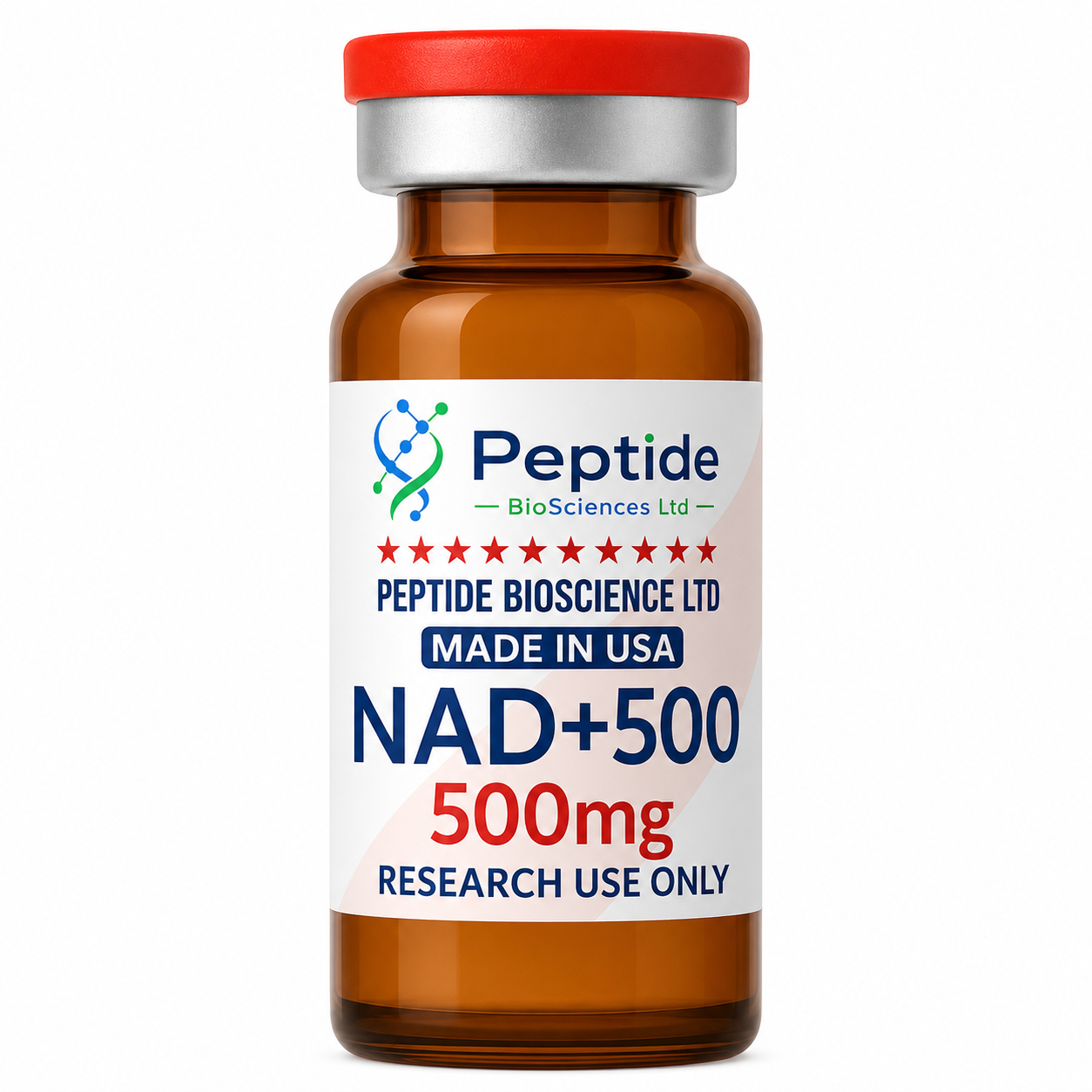
NAD+ 500mg
Original price was: $42.99.$33.99Current price is: $33.99.
- Nicotinamide Adenine Dinucleotide — essential redox coenzyme (NAD⁺/NADH cycling)
- 500mg research quantity for sirtuin, PARP, and CD38 pathway studies
- 99% pure (HPLC verified) · Third-party lab tested · CAS 53-84-9
- For in vitro metabolic research only
NAD+ 500mg — Nicotinamide Adenine Dinucleotide
Every living cell runs on NAD+ 500mg. That is not hyperbole — this dinucleotide coenzyme participates in over 500 enzymatic reactions, acts as an electron shuttle in the core energy-producing pathways of the cell, and serves as the consumed substrate for three competing enzyme families that regulate everything from gene expression to DNA repair to inflammatory signaling.
What makes NAD+ 500mg unusual as a research compound is its dual nature. In redox reactions — glycolysis, the citric acid cycle, oxidative phosphorylation — it functions as a recyclable coenzyme, accepting and donating electrons as NAD+ and NADH. But sirtuins, PARPs, and CD38 actually consume it. They break NAD+ apart to do their work, depleting the cellular pool. This creates a resource competition at the molecular level that sits at the center of aging and metabolic research. Buy online at Peptide Bio Sciences LTD
The three-way competition
Sirtuins (SIRT1-7) are NAD+-dependent deacylases that regulate gene expression, DNA repair, and stress responses. PARPs consume NAD+ to build poly(ADP-ribose) chains during DNA damage repair. CD38 uses NAD+ for calcium signaling through cADPR synthesis. All three enzyme families draw from the same NAD+ 500mg pool, and published research shows that pool shrinks substantially with age across multiple tissue types (Covarrubias et al., Nature Reviews Molecular Cell Biology, 2021).
The implications are significant: when PARP activates during DNA damage, it can drain enough NAD+ to starve sirtuin-mediated regulatory functions. Wang et al. examined this dynamic specifically in the context of base excision repair after ischemic stress (Stroke, 2008; PubMed 18635843).
Specifications
| Molecular Formula | C21H27N7O14P2 |
| Molecular Weight | 663.43 g/mol |
| CAS Number | 53-84-9 |
| PubChem CID | 5893 |
| Structure | Two nucleotides joined via phosphate groups — one with adenine base, one with nicotinamide |
| Form | Lyophilized powder |
| Appearance | White to off-white powder |
| Solubility | Freely soluble in water |
| Available Sizes | 500mg and 1000mg per vial |
Selected research
Mills et al. published one of the landmark studies in NAD+ precursor research — a 12-month NMN administration study in normal-aging mice that tracked body weight, energy metabolism, and a range of metabolic parameters over time (Cell Metabolism, 2016; PubMed 28068222). Zhang et al. examined the downstream consequences for mitochondrial and stem cell function (Cell, 2016). Imai et al. reviewed the broader NAD+ 500mg metabolism landscape comprehensively (Nat Rev Mol Cell Biol, 2024).
Research applications
- Sirtuin activity assays and NAD+-dependent deacylase research
- PARP activation and DNA damage repair studies
- Cellular bioenergetics and electron transport chain research
- Redox biochemistry — NAD+/NADH ratio quantification
- CD38 enzymatic regulation and cADPR signaling
- Mitochondrial function and oxidative phosphorylation
Quality and testing
Third-party tested. Batch-specific COAs available for all orders.
Storage
- Lyophilized: -20°C for long-term stability
- Reconstituted: 2-8°C
- Protection: Shield from light and moisture
References
- Covarrubias AJ, et al. “NAD+ metabolism and its roles in cellular processes during ageing.” Nat Rev Mol Cell Biol. 2021;22(2):119-141.
- Mills KF, et al. “Long-term administration of nicotinamide mononucleotide mitigates age-associated physiological decline in mice.” Cell Metabolism. 2016;24(6):795-806. PubMed 28068222
- Zhang R, et al. “NAD+ repletion improves mitochondrial and stem cell function.” Cell. 2016;124(3):423-436.
- Wang S, et al. “NAD+ repletion and base excision repair after ischemic stress.” Stroke. 2008;39(9):2587-2595. PubMed 18635843
- Imai S, et al. “Roles of NAD+ metabolism in cellular signaling and disease.” Nat Rev Mol Cell Biol. 2024;25:452-467.
- Rajman L, et al. “Therapeutic potential of NAD-boosting molecules.” Cell Metabolism. 2018;27(3):529-547.
For laboratory research use only. Not for human or veterinary use. Not a drug, food, or cosmetic.
Be the first to review “NAD+ 500mg”
Related products
Reviews
There are no reviews yet.