
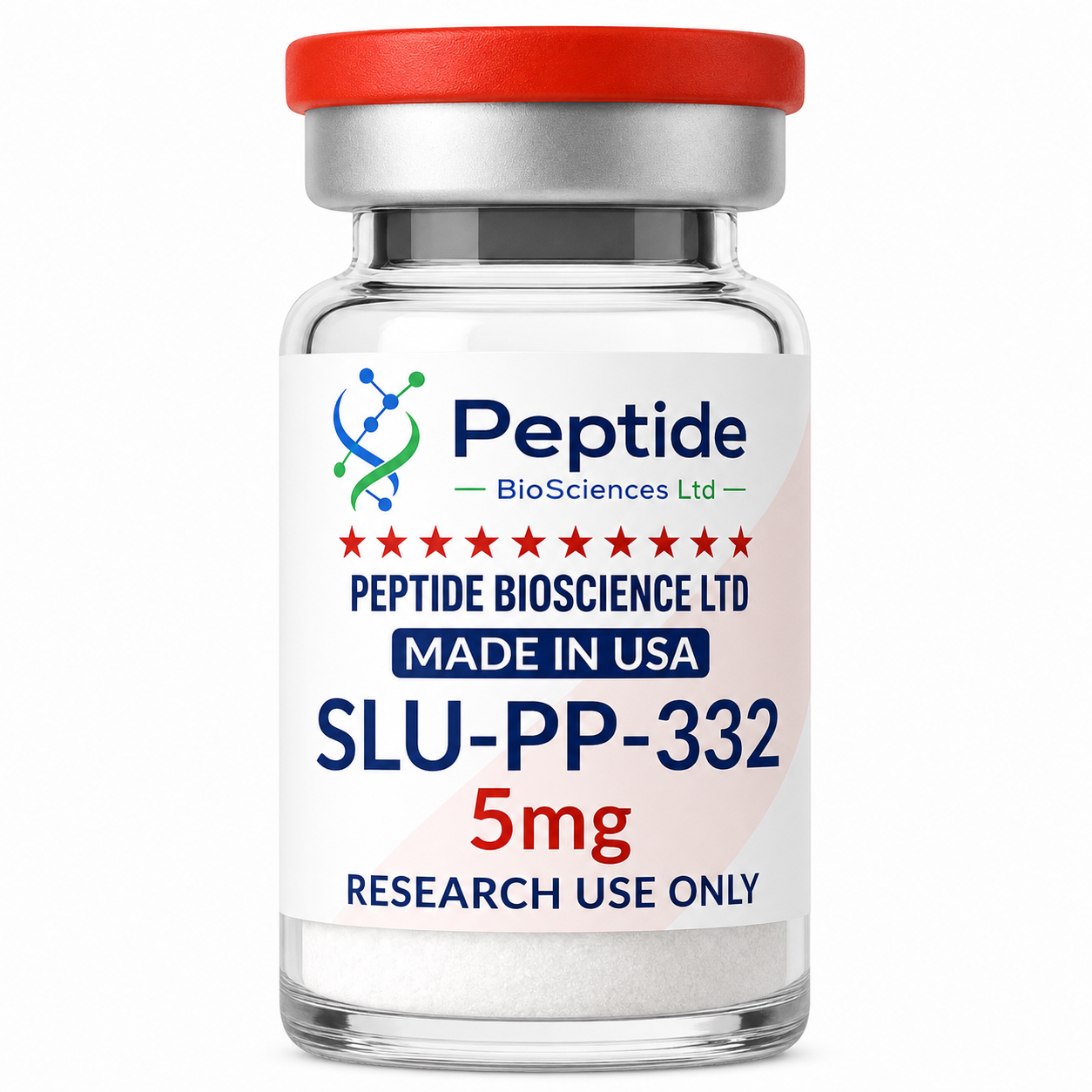
SLU-PP-332 5mg
Original price was: $55.99.$41.99Current price is: $41.99.
- Synthetic ERRα/ERRγ agonist — developed at Saint Louis University
- Studied in PGC-1α coactivator recruitment and mitochondrial biogenesis gene expression
- 99% pure (HPLC verified) · Third-party lab tested · Lyophilized powder
- For in vitro ERR pathway research only
SLU-PP-332 (5 mg)
SLU-PP-332 5mg is a synthetic small molecule that functions as an agonist of the estrogen-related receptors alpha and gamma (ERRα and ERRγ). It is not a peptide but a non-steroidal, non-hormonal organic compound developed as a research tool for studying the ERR family of orphan nuclear receptors. Each vial contains 5 mg of lyophilized SLU-PP-332 5mg, sealed under inert conditions in a glass vial with a rubber stopper and aluminum crimp cap.
Despite the “estrogen-related” designation, the ERR family of receptors does not bind estrogen and is not part of the estrogen signaling pathway. The name is historical — ERRα was identified through sequence homology to the estrogen receptor, but subsequent research established that ERR receptors are constitutively active orphan nuclear receptors with distinct ligand-binding properties and biological functions. SLU-PP-332 was specifically designed to target these receptors without cross-reactivity to the classical estrogen receptors (ERα and ERβ).
Molecular Characteristics
SLU-PP-332 was developed at Saint Louis University (the “SLU” in its name) by the research group of Thomas Bhursch. The compound has a molecular weight of approximately 508.6 g/mol. Its IUPAC name is ethyl 2-amino-4-(2-(dimethylamino)-1-(1-(4-(trifluoromethyl)phenyl)-1H-indol-3-yl)ethyl)thiophene-3-carboxylate. The molecular formula is C26H26F3N3O2S. It is a synthetic indole derivative, not derived from biological sources, and is produced through multi-step organic synthesis.
The compound belongs to the class of inverse agonist/agonist modulators targeting orphan nuclear receptors — a category of transcription factors for which endogenous ligands have not been definitively identified. ERRα and ERRγ are constitutively active, meaning they can drive gene transcription without a bound ligand. SLU-PP-332 was designed to further increase this transcriptional activity, making it a valuable tool for researchers studying the downstream effects of ERR activation.
Research Context and Published Literature
The ERR family has been the subject of growing research interest due to its role in regulating genes involved in energy metabolism, mitochondrial function, and oxidative phosphorylation. Kim et al. (2011) published one of the foundational characterization studies of SLU-PP-332 5mg in the journal Molecular Pharmacology, demonstrating the compound’s selectivity for ERRα and ERRγ over other nuclear receptors. The study reported that SLU-PP-332 5mg activated ERR-dependent transcription in cell-based reporter assays without significant activity at other nuclear receptor targets.
Subsequent studies have used SLU-PP-332 5mg as a chemical probe to investigate ERR signaling. Willy et al. (2004) and Rangwala et al. (2010) provided context for the broader ERR field with publications in the Proceedings of the National Academy of Sciences and Molecular Endocrinology, respectively, establishing the metabolic gene networks regulated by ERRα and ERRγ. SLU-PP-332 has been cited as a tool compound in multiple follow-up studies investigating these pathways at the cellular and molecular level.
The compound gained broader attention in 2023-2024 when Cho et al. published work in the Journal of Medicinal Chemistry further characterizing SLU-PP-332 analogs and their selectivity profiles within the ERR family. This body of work has positioned SLU-PP-332 5mg as one of the most widely referenced ERR agonist tool compounds in the current literature.
Solubility and Reconstitution
SLU-PP-332 5mg is a small organic molecule, not a peptide, and its solubility profile differs accordingly. The compound is poorly soluble in pure water. It is soluble in DMSO (dimethyl sulfoxide) at concentrations up to approximately 50 mM, and in ethanol at lower concentrations. For cell-based research, the standard approach is to prepare a concentrated stock solution in DMSO and then dilute into the working medium at the desired final concentration, keeping the final DMSO concentration below 0.1% to avoid solvent effects on the experimental system.
When preparing DMSO stock solutions, add the DMSO directly to the lyophilized powder in the vial. Vortex or pipette-mix until completely dissolved. The solution should be clear. Store aliquots at -20°C. Avoid repeated freeze-thaw cycles by dividing the stock into single-use volumes at the time of preparation.
Purity and Analytical Testing
Peptide Bio Sciences LTD verifies the identity and purity of SLU-PP-332 5mg through third-party analytical testing. Each production lot undergoes HPLC analysis for purity determination and mass spectrometry for molecular identity confirmation. Because SLU-PP-332 5mg is a small molecule rather than a peptide, the chromatographic conditions (column chemistry, mobile phase, gradient) are optimized for small-molecule analysis rather than the peptide-specific RP-HPLC methods used for amino acid-based compounds.
Certificates of Analysis for each lot are available through the Peptide Bio Sciences LTD COA Portal. The COA includes HPLC purity data, mass spectrometry confirmation, and appearance description.
Storage Recommendations
Store the sealed, lyophilized vial at -20°C (freezer) for maximum long-term stability. The compound is stable at 2-8°C (refrigerator) for intermediate-term storage. Protect from light and moisture. The lyophilized form is significantly more stable than dissolved solutions — reconstitute only the amount needed for your immediate research period.
DMSO stock solutions should be stored at -20°C in tightly sealed vials or microcentrifuge tubes. DMSO is hygroscopic and will absorb atmospheric moisture if left uncapped, which can alter the solution concentration and introduce water into a solvent that should remain anhydrous. Aliquot into single-use volumes at the time of initial preparation to avoid repeated freeze-thaw cycles and minimize moisture exposure.
Research Applications and Ordering
SLU-PP-332 5mg is intended for in vitro and laboratory research use only. It is provided as a research tool compound for investigators studying ERR-dependent transcriptional regulation, mitochondrial biogenesis pathways, and related areas of nuclear receptor biology. The compound is available in the Peptide Bio Sciences LTD at the 5mg size.
Be the first to review “SLU-PP-332 5mg”
Related products
Reviews
There are no reviews yet.