
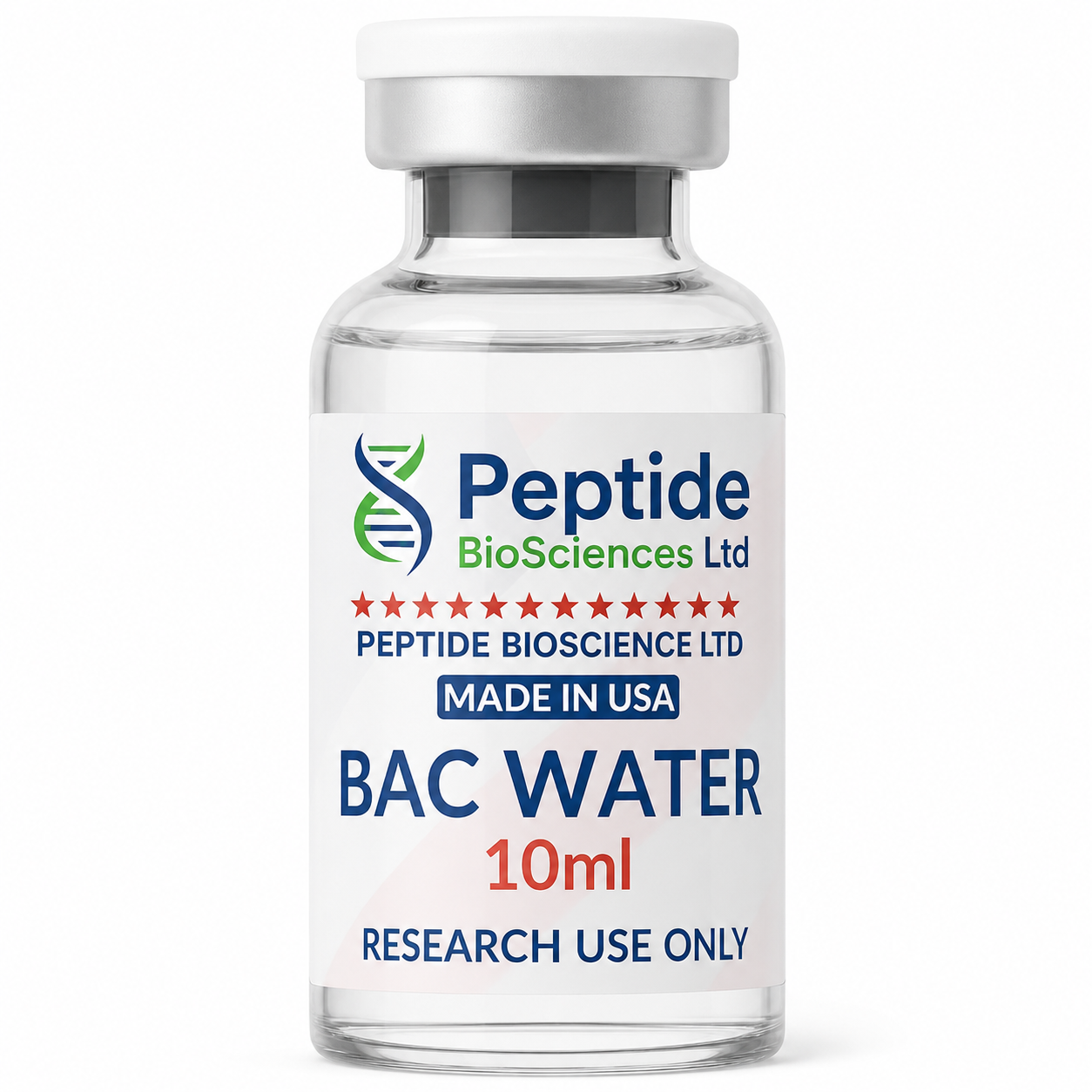
Bacteriostatic Water 10ml
Original price was: $37.99.$27.99Current price is: $27.99.
- Sterile, non-pyrogenic water with 0.9% benzyl alcohol preservative
- Multi-dose 10ml vial — standard reconstitution solvent for lyophilized peptides
- Third-party lab tested · pH 4.5-7.0
- For laboratory research use only
Bacteriostatic Water 10ml – Reconstitution Solution 10 mL — USP-Grade Reconstitution Solvent
Bacteriostatic Water 10ml (Reconstitution Solution) is the standard reconstitution solvent for lyophilized research peptides. This 10 mL vial contains sterile water for injection (USP) preserved with 0.9% benzyl alcohol (NF) — the United States Pharmacopeia specification for multi-use parenteral preparations. The formulation is manufactured under aseptic conditions and sealed in a Type I borosilicate glass vial with a rubber stopper and aluminum crimp cap to maintain sterility through the labeled shelf life.
Specifications
| Volume | 10 mL |
| Composition | Sterile Water for Injection (USP) + 0.9% Benzyl Alcohol (NF) |
| Appearance | Clear, colorless, free of visible particulates |
| pH Range | 4.5–7.0 |
| Container | Type I borosilicate glass vial, rubber stopper, aluminum crimp seal |
| Grade | USP |
| Origin | Made in USA |
Benzyl Alcohol: Mechanism of Antimicrobial Preservation
Benzyl alcohol (C6H5CH2OH, molecular weight 108.14 g/mol, CAS 100-51-6) functions as a bacteriostatic preservative — it inhibits bacterial reproduction without necessarily killing existing organisms. The mechanism involves disruption of bacterial cell membrane integrity and interference with membrane-associated transport processes, preventing colonization of the solution after the sealed environment is breached by a needle puncture. At the 0.9% concentration specified by USP, benzyl alcohol provides reliable antimicrobial preservation that permits multiple draws from a single vial over a 28-day period (United States Pharmacopeia, General Chapter <51> Antimicrobial Effectiveness Testing).
The preservative is compatible with the vast majority of research peptides. Benzyl alcohol does not react with or hydrolyze peptide bonds under standard storage conditions (2–8°C). In rare cases, specific peptides may be documented as incompatible with benzyl alcohol — in those situations, preservative-free sterile water is appropriate, with the understanding that the reconstituted solution cannot be stored for repeated draws.
Why Reconstitution Solution
Lyophilized peptides are supplied as dry powders to maximize chemical stability during shipping and storage. Reconstitution with an appropriate solvent is required before the peptide can be used in research applications. Reconstitution Solution is the preferred solvent for most peptides because the benzyl alcohol preservative enables multi-use access to a single reconstituted vial over the 28-day window — critical for research protocols that draw small volumes over multiple sessions rather than consuming an entire vial at once. Buy Bacteriostatic Water 10ml
Alternative solvents include sterile water (no preservative, single-use only), acetic acid water (0.6% acetic acid, used for peptides with poor solubility at neutral pH), and sodium chloride 0.9% (isotonic saline). The choice depends on the specific peptide’s solubility profile and the research protocol requirements. For most lyophilized peptides — including GHRPs, GHRH analogs, BPC-157, and melanocortin peptides — Bacteriostatic Water 10ml solution is the standard.
Bacteriostatic Water 10ml Volume Advantage: 10 mL Format
The 10 mL vial is designed for researchers working with multiple peptide compounds or conducting extended research protocols. A researcher reconstituting five different compounds at 2 mL each requires 10 mL of solvent — a single 10 mL vial consolidates this into one container with one 28-day tracking date, compared to four separate 3 mL vials. The larger format also delivers a lower per-milliliter cost, as vial packaging, sterilization, and quality testing are fixed costs per unit regardless of fill volume.
Bacteriostatic Water 10ml Proper Handling and Storage
Store unopened vials at controlled room temperature (20–25°C) in original packaging, protected from direct sunlight. Do not freeze — freezing may compromise the vial seal or create micro-fractures in the glass that are not visible on inspection. After first puncture, refrigerate at 2–8°C and mark the date on the vial. The 28-day use window begins at first puncture, not at date of receipt. Buy Bacteriostatic Water 10ml
Before each draw, disinfect the rubber stopper with a 70% isopropyl alcohol swab and allow it to air-dry. Use a new sterile needle for each puncture (29–31 gauge recommended) to minimize stopper coring. With a 10 mL vial, the stopper will endure more punctures over its lifespan — vary the puncture location across the stopper surface to distribute wear. If the stopper becomes visibly damaged or produces rubber fragments, discard the vial regardless of remaining volume or elapsed time. Buy Bacteriostatic Water 10ml
Reconstitution Best Practices
When drawing reconstitution solution for peptide reconstitution, invert the vial and insert the needle through the center of the stopper. Draw slowly to the desired volume — rapid withdrawal creates air bubbles that compromise measurement accuracy. Inject the solvent into the peptide vial by directing the stream along the inside glass wall, not directly onto the lyophilized powder cake. Swirl the peptide vial gently in a circular motion until the powder dissolves completely. Do not shake, vortex, or invert vigorously — mechanical agitation can denature peptide secondary structure. For a complete reconstitution protocol including concentration calculations, see the Peptide Bio Sciences LTD Reconstitution Guide.
Quality Verification
Every production lot of Peptide Bio Sciences LTD reconstitution solution is manufactured in the United States and tested against USP specifications for sterility, bacterial endotoxin levels (LAL testing), particulate matter, pH, and benzyl alcohol concentration. Each vial undergoes visual inspection for particulates and container integrity. Quality documentation is available through the Peptide Bio Sciences LTD COA Portal.
When to Choose 10 mL vs. 3 mL
The 10 mL vial is the appropriate choice when more than 3 mL of reconstitution solution will be consumed within a 28-day window. For researchers reconstituting only one or two peptide vials at low volumes, the 3 mL size ensures full utilization before the 28-day expiration. Both the 3 mL and 10 mL reconstitution solution vials, along with acetic acid water and the full research peptide catalog, are available in the Peptide Bio Sciences LTD.
For laboratory research use only. Not for human or veterinary use.
Be the first to review “Bacteriostatic Water 10ml”
Related products
Reviews
There are no reviews yet.