
Guide
Lyophilized Versus Liquid Peptides Compared
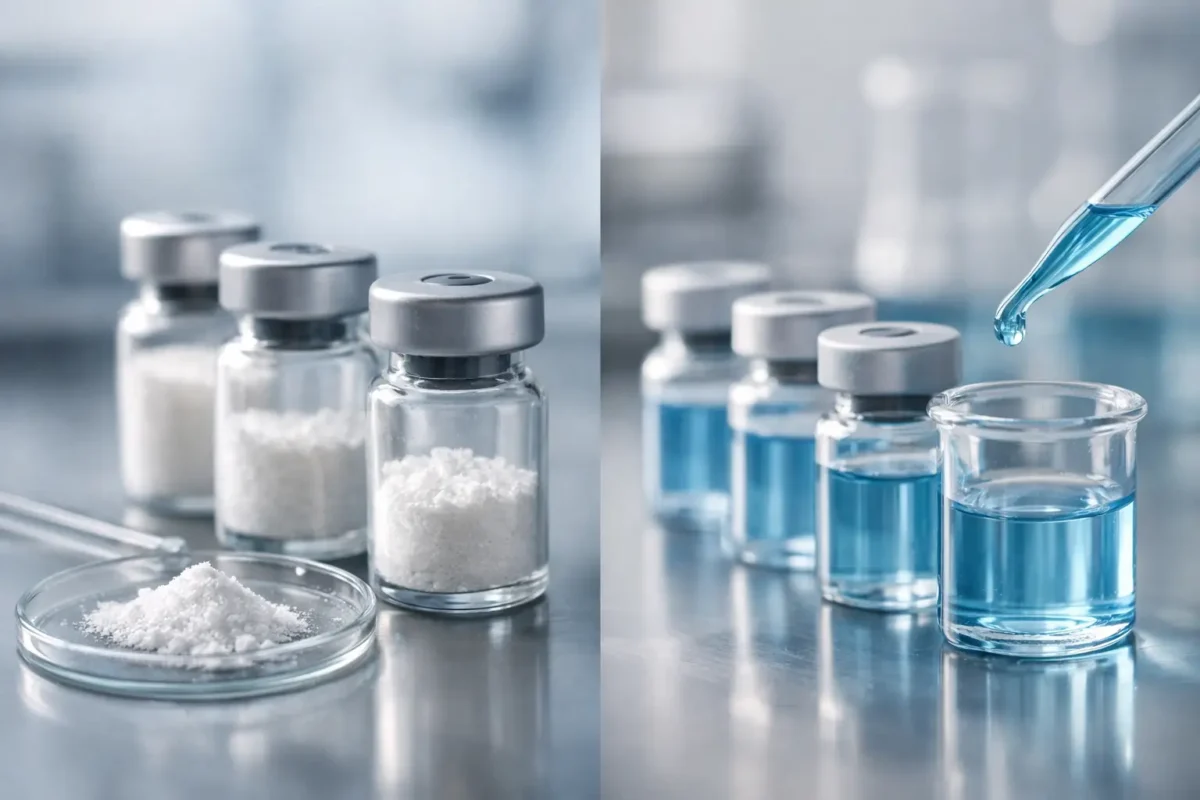
A peptide can arrive in a vial as a dry, porous cake or as a pre-made solution, yet those formats create very different demands on a research workflow. In the lyophilized versus liquid peptides decision, the better choice is not universal. It depends on the molecule, anticipated storage time, shipping conditions, available cold-chain controls, and whether your protocol can accommodate reconstitution.
For research buyers, format is more than a convenience feature. It can affect material handling, concentration control, repeatability, and the practical risk of degradation before a study begins. The right comparison starts with understanding what each format is designed to do – and what neither format can guarantee on its own.
What Lyophilized Peptides Are
Lyophilized peptides have undergone freeze-drying, a process that removes water from a frozen peptide solution under controlled vacuum conditions. The remaining material is typically a dry powder or cake in a sealed vial. Before use in a research protocol, the material is reconstituted with a suitable laboratory solvent according to the supplier documentation and the requirements of the experiment.
Water is a major driver of many chemical and physical degradation pathways. Removing it can help reduce hydrolysis, microbial growth risk, and other instability concerns during storage. That is why lyophilized material is commonly selected when a peptide must tolerate transit, inventory time, or handling across multiple research locations.
Still, “dry” does not mean indestructible. Some peptides remain sensitive to heat, oxygen, light, residual moisture, agitation, or repeated temperature changes. The vial stopper, seal integrity, headspace environment, formulation, and storage temperature all matter. A lyophilized vial should be handled as a controlled research material, not as a shelf-stable commodity that can be stored carelessly.
Reconstitution adds a controlled step
The principal trade-off with lyophilized peptides is reconstitution. The researcher must select the appropriate compatible solvent, calculate the intended concentration, use suitable aseptic technique, and document the final preparation. That introduces an additional workflow step, but it also provides flexibility.
For example, a 10 mg vial reconstituted with 2 mL of a compatible solution yields a nominal concentration of 5 mg/mL. Reconstituting that same vial with 1 mL yields 10 mg/mL. The peptide quantity in the vial has not changed, but the working concentration has. Clear labels, verified calculations, and protocol-specific records are essential for avoiding avoidable variability.
A reconstitution calculator can simplify the arithmetic, but it does not replace material-specific documentation or qualified laboratory judgment. A calculator confirms concentration math. It cannot determine whether a particular solvent, storage condition, or concentration is appropriate for a given peptide and research method.
What Liquid Peptides Are
Liquid peptides are supplied already dissolved in a defined solution. Depending on the product, that solution may include a buffer, stabilizing components, or other formulation elements intended to maintain solubility and support product performance within stated storage parameters.
The obvious benefit is speed. A pre-formulated liquid removes the initial dissolution step and provides a known labeled concentration from the start. This can reduce handling time and eliminate one common source of calculation or transfer error, particularly where a protocol requires frequent preparation of the same concentration.
That convenience comes with a narrower margin for storage mistakes. Once a peptide is in solution, it may be more exposed to hydrolysis, oxidation, aggregation, adsorption to surfaces, contamination, or degradation from repeated freeze-thaw cycles. The degree of risk varies significantly by peptide sequence, formulation, vial design, and storage conditions.
A liquid product is not automatically less stable than a lyophilized product. A properly developed liquid formulation may be highly suitable for its stated use period and storage conditions. Conversely, an improperly stored liquid may lose integrity quickly. The product-specific specifications, not the format alone, should guide the decision.
Lyophilized Versus Liquid Peptides: The Practical Differences
The choice often comes down to how long the material needs to remain dependable before the study uses it. Lyophilized material generally offers practical advantages for inventory management and shipping because it begins with minimal water content. This is particularly relevant when research materials may encounter transit delays or when labs prefer to reconstitute only the quantity needed for a defined phase of work.
Liquid material can be a strong fit for short-cycle workflows where rapid use, a fixed concentration, and reduced preparation steps are priorities. It may also improve consistency when a validated formulation is needed repeatedly and the lab can maintain the supplier’s storage requirements without interruption.
Neither option eliminates the need for proper handling. A lyophilized vial can take on moisture if stored improperly or opened in an uncontrolled environment. A liquid vial can be compromised by excessive warming, repeated vial access, or poor temperature control. In both cases, storage instructions should be treated as part of the product specification, not as optional guidance.
Purity Is Not the Same as Stability
A 99%+ purity claim and a certificate of analysis are important quality markers, but they answer specific questions. Analytical purity testing can indicate the proportion of the intended peptide relative to detectable impurities at the time of testing. Identity testing helps confirm that the material is what the label states. These are foundational checks for research procurement.
They do not automatically establish long-term stability after shipping, storage, or reconstitution. Stability is a separate consideration that depends on time, temperature, formulation, packaging, and the molecule itself. Researchers should review available batch documentation and product handling instructions together rather than treating a purity percentage as a complete picture of quality.
For high-value work, procurement standards should include verified batch information, third-party testing where available, accessible COAs, traceable vial strength, and clear storage guidance. Manufacturing controls also matter. GMP-compliant production practices, appropriate packaging, and consistent lot documentation help reduce uncertainty before a vial reaches the laboratory.
Shipping and Storage Should Influence the Purchase Decision
Shipping is where the format question becomes operational. A dry peptide may be better suited to a supply chain with variable transit conditions, provided the manufacturer’s validated shipping and storage parameters are followed. That does not mean it can be exposed to arbitrary heat or humidity without consequence.
Liquid products require particularly close attention to transit temperature, delivery timing, and immediate storage on receipt. Before purchasing, confirm the stated shipping method, expected delivery window, packaging approach, and required storage conditions. If your lab cannot receive or transfer temperature-sensitive materials promptly, convenience at the time of preparation may be outweighed by logistical risk.
On receipt, inspect the package and vial condition, confirm the label against the order record, and document the lot number. Quarantine material that arrives damaged, mislabeled, visibly compromised, or outside documented temperature expectations. A consistent receiving process protects both the study and the budget.
Choosing the Format for Your Workflow
Lyophilized peptides may be the more practical option when your lab needs flexible concentration planning, longer inventory management, or reduced exposure to solution-state degradation before use. They are also useful when researchers prefer to prepare fresh solutions under their own documented procedures.
Liquid peptides may make sense when time-sensitive workflows benefit from an immediate, fixed concentration and the research team has reliable cold storage and short planned use intervals. The best candidate is a product with transparent formulation information, validated handling guidance, and documentation that supports the intended study design.
Do not select a format solely because it appears easier. Consider the full chain: receiving, storage, reconstitution or preparation, labeling, aliquoting where appropriate, protocol use, and records. The least complicated vial is not always the lowest-risk material.
All peptides should be purchased and handled strictly for legitimate laboratory and research applications by qualified personnel using appropriate protective equipment and institutional procedures. They are not intended for human consumption, self-administration, clinical use, or treatment of any condition.
A well-run peptide workflow begins before the vial is opened. Choose the format that your laboratory can store, document, and use with the greatest consistency, then let verified specifications – not convenience alone – guide the decision.