
Guide
Preventing Reconstitution Calculation Errors
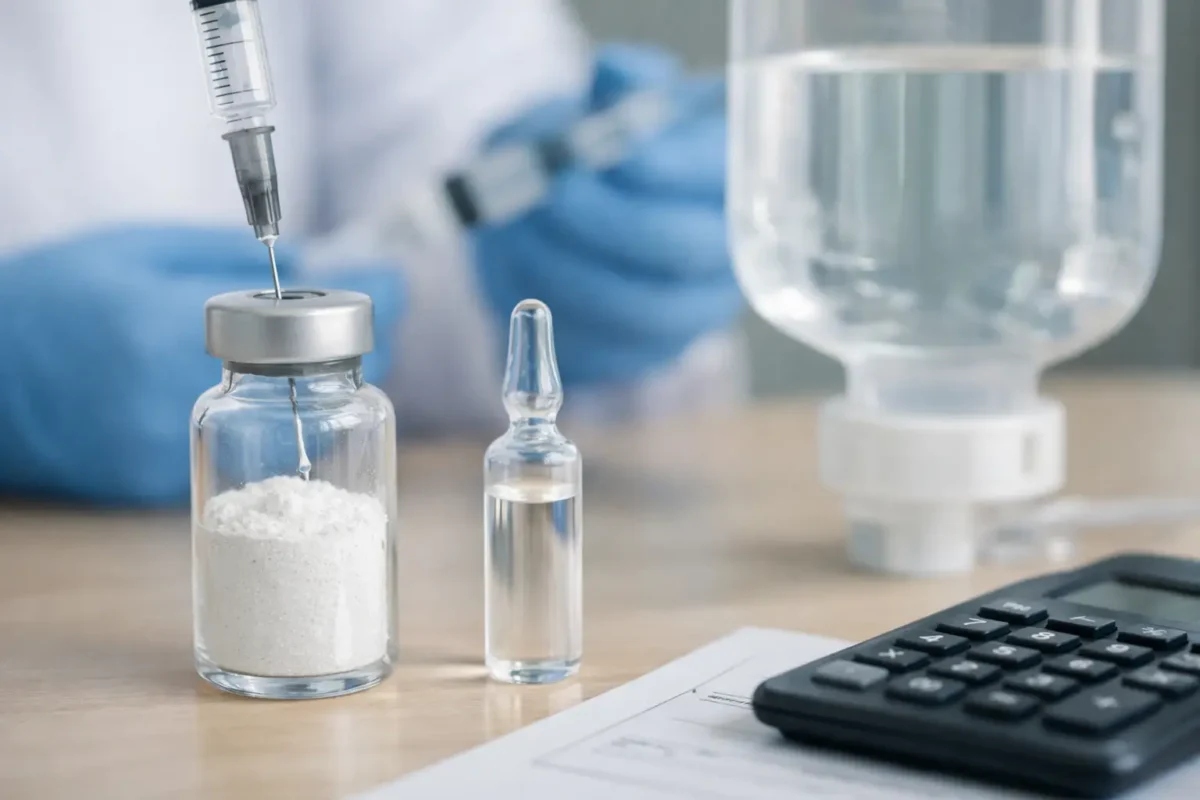
A vial can be correctly labeled, third-party tested, and stored appropriately, yet still produce unreliable research data if the concentration is calculated incorrectly. Reconstitution calculation errors usually begin with one small mismatch: milligrams are read as micrograms, the wrong diluent volume is recorded, or a transfer-device scale is mistaken for a concentration value. In peptide research, that is enough to compromise repeatability across an entire protocol.
For qualified laboratory use, reconstitution is not a casual preparation step. It is a controlled conversion from a known lyophilized vial mass into a known liquid concentration. The calculation must be traceable, independently checkable, and documented alongside the vial lot, reconstitution date, and storage conditions.
Where Reconstitution Calculation Errors Start
Most errors occur before any math is performed. A researcher may begin with an assumed vial strength rather than the actual labeled amount, use an unrecorded diluent volume, or copy a value from a prior protocol that used a different vial size. These are workflow errors first and arithmetic errors second.
The foundational relationship is straightforward:
`Concentration (mcg/mL) = vial mass (mg) × 1,000 ÷ reconstitution volume (mL)`
If a research vial contains 5 mg of material and is reconstituted with 2 mL of compatible laboratory diluent, the concentration is 2,500 mcg/mL. The concentration does not change because of the vial label design, the purity claim, or the device used to transfer the liquid. It changes only when the verified material mass or final liquid volume changes.
This distinction matters. A 99%+ purity standard, GMP-compliant manufacturing, and a supporting certificate of analysis help establish confidence in the supplied research material. They do not replace a protocol-specific calculation. Product verification and correct reconstitution are separate controls, and both are required for dependable work.
The Unit Conversion That Causes the Most Mistakes
Milligrams and micrograms are often written close together in research notes, but they are not interchangeable. One milligram equals 1,000 micrograms. Missing that conversion creates a thousand-fold calculation error, not a minor rounding issue.
Use one unit system from beginning to end whenever possible. If the vial is labeled in milligrams and the protocol quantity is expressed in micrograms, convert the vial mass once before calculating concentration. For example, 10 mg equals 10,000 mcg. When 10,000 mcg is reconstituted in 4 mL, the resulting concentration is 2,500 mcg/mL.
To determine the liquid volume corresponding to a defined research-protocol quantity, use the reverse formula:
`Volume (mL) = target quantity (mcg) ÷ concentration (mcg/mL)`
A protocol requiring 500 mcg from a 2,500 mcg/mL preparation corresponds to 0.2 mL. That value should be recorded as a volume in mL before it is converted to any device-specific graduation scale.
Four Common Reconstitution Calculation Errors
Confusing vial mass with concentration
A vial labeled 5 mg contains a total mass, not a ready-made concentration. The concentration exists only after the final reconstitution volume is known. Two 5 mg vials can produce very different concentrations if one is prepared in 1 mL and another in 2 mL.
This is especially relevant when the same material is available in multiple vial strengths. Never carry over the concentration from a 5 mg workflow to a 10 mg vial without recalculating from the actual vial mass and diluent volume.
Recording the intended volume instead of the delivered volume
The calculation depends on the volume actually introduced into the vial. If a protocol calls for 2 mL but only 1.8 mL is delivered, the concentration is higher than the worksheet indicates. Conversely, adding extra diluent reduces concentration.
Laboratory teams should record the delivered volume immediately, rather than relying on memory later. Where precision requirements are high, use appropriately calibrated equipment and follow the relevant laboratory SOP for volume verification.
Treating transfer-device units as universal units
Graduation marks are device-specific. A U-100 scale, for example, represents 100 marked units per 1 mL, meaning 0.1 mL corresponds to 10 marked units on that specific scale. That conversion is a volume reference only. It does not convert milligrams into micrograms, and it must not be assumed for a device with a different calibration.
The correct order is always mass to concentration, concentration to volume, then volume to the verified device scale if the protocol requires it. Skipping directly from vial mass to marked units is a frequent source of reconstitution calculation errors.
Using rounded values too early
Rounding 2,500 mcg/mL to 2,000 mcg/mL for convenience may appear harmless, but it introduces avoidable variation. Keep full practical precision through the calculation, then round only at the final reporting or measurement stage according to the protocol and equipment resolution.
There is a trade-off here. Excessive decimal places can imply a precision the equipment cannot deliver, while aggressive early rounding can distort the result. The right standard is documented, instrument-appropriate precision.
Build a Two-Person Verification Step
The simplest safeguard is a calculation check performed by someone other than the person who prepared the vial. The verifier should confirm the vial label, total mass, diluent volume, unit conversion, concentration, and final volume value independently. They should not simply review the first person’s answer and agree with it.
For solo workflows, separate the preparation and verification stages. Complete the initial calculation, step away from the worksheet, then recalculate from the original label and protocol fields. A calculator can reduce arithmetic mistakes, but it cannot identify an incorrect vial strength, a misplaced decimal, or an unrecorded volume change.
Peptide Biosciences LTD provides a research-protocol calculator to help convert vial quantity and reconstitution volume into concentration and volume fields. It should be used as a verification tool, not as a substitute for reviewing the vial label, certificate of analysis, laboratory documentation, and qualified handling requirements.
Document the Variables That Matter
A calculation is only reproducible when another qualified researcher can reconstruct it. The preparation record should identify the material name, vial strength, lot or batch reference, reconstitution date, diluent type, final diluent volume, calculated concentration, preparer, and verifier. Record storage conditions and any observed deviations separately rather than trying to correct them mentally in later calculations.
Clear records also make troubleshooting faster. If results differ between runs, the team can compare batch documentation, concentration, storage time, equipment, and protocol conditions instead of guessing whether a calculation changed. This is where transparent COAs, verified purity documentation, and disciplined lab records work together.
Keep the Research Boundary Clear
These calculations are intended strictly for laboratory and research applications. They are not clinical instructions, medical guidance, or a basis for human use. Research materials should be handled only by qualified personnel using appropriate protective equipment, validated procedures, and the applicable institutional requirements.
The best calculation is the one another trained researcher can verify without assumptions. Start with the labeled mass, record the actual volume, keep units consistent, and make every conversion visible on the worksheet. That level of control protects the integrity of the research long before results reach the data table.