
Guide
Peptide Dosage Calculator for Clearer Lab Math
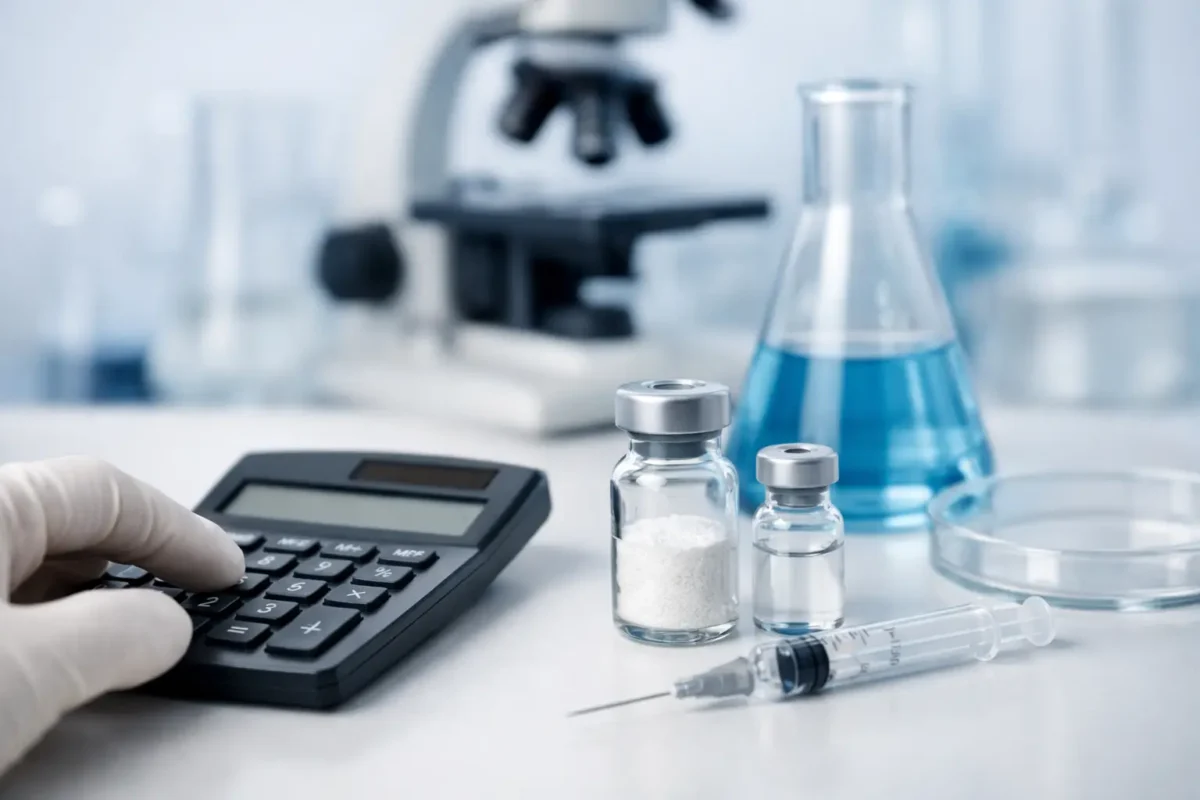
A mislabeled decimal can compromise weeks of research. A peptide dosage calculator is built to prevent that problem by translating vial mass, reconstitution volume, and a protocol-defined target amount into values a research team can verify, record, and reproduce. It is a calculation tool, not a substitute for an approved research protocol, qualified handling, or laboratory controls.
For peptide-focused research, the arithmetic itself is straightforward. The risk comes from mixing units, assuming a syringe marking is a universal measurement, or carrying an unverified concentration from one batch into the next. A disciplined calculator workflow makes each input visible before material is handled.
What a peptide dosage calculator actually calculates
A calculator starts with the total mass of material in a vial, usually stated in milligrams, and the volume of diluent introduced during reconstitution, usually stated in milliliters. From those two figures, it determines concentration.
The core equation is:
Concentration (mg/mL) = vial mass (mg) ÷ reconstitution volume (mL)
Because many peptide protocols are expressed in micrograms, the calculator should also convert milligrams to micrograms. One milligram equals 1,000 micrograms. That conversion matters because a missed zero at this stage changes the result by a factor of 1,000.
Once concentration is established, the calculator can determine the liquid volume associated with a protocol-defined research target:
Volume (mL) = target amount (mcg) ÷ concentration (mcg/mL)
If the workflow uses a U-100 insulin syringe as a volume-marking device, the calculator may display equivalent syringe units. A U-100 syringe has 100 units per mL, so one unit represents 0.01 mL. This is only a volume conversion. Syringe units are not a peptide measurement, and syringe calibration formats are not interchangeable.
Start with verified vial information
No calculation can correct a bad input. Before entering a vial amount, confirm the labeled net peptide content and review the batch documentation associated with that material. The certificate of analysis should match the product and lot being used. Purity documentation, identity testing, and manufacturing controls support confidence in the starting material, but they do not replace proper reconstitution and recordkeeping.
This is where quality and calculation meet. A precision-synthesized, third-party tested material with stated 99%+ purity gives researchers a clearer basis for controlled work. It does not authorize assumptions about concentration after reconstitution. The mass entered into the calculator should always be the labeled vial amount, while reconstitution volume should be the actual volume introduced and documented.
For example, a vial labeled 10 mg contains 10,000 mcg of material. If the laboratory adds 2 mL of bacteriostatic water according to its approved protocol, the resulting concentration is 5 mg/mL, or 5,000 mcg/mL. The calculator then uses that concentration to translate a protocol-defined target amount into a liquid volume. It should never be used to invent a target amount or infer one from online anecdotes.
The inputs that deserve a second check
Most calculation errors happen before the Calculate button is pressed. A reliable workflow pauses at three points: vial mass, diluent volume, and units.
First, distinguish milligrams from micrograms. A 5 mg vial is not the same as 5,000 mg. It is 5,000 mcg. Second, enter the reconstitution volume in mL, not syringe units, unless the calculator explicitly requests units and identifies the syringe standard. Third, confirm whether the target amount in the protocol is written per observation, per sample, per interval, or as a total amount. Those terms cannot be treated as equivalent.
A useful calculator displays the math rather than only a final answer. Researchers should be able to see total mass in the vial, concentration in mg/mL and mcg/mL, calculated liquid volume, and any U-100 unit conversion. Transparent outputs make peer review and error checks faster.
Why reconstitution volume changes the answer
Adding more diluent does not change the total peptide mass in the vial. It changes concentration. A 10 mg vial reconstituted with 1 mL is twice as concentrated as the same vial reconstituted with 2 mL. The total available amount remains 10 mg in both cases, but the volume required to reach the same protocol-defined quantity differs.
That trade-off is practical. A higher concentration can reduce liquid volume, while a lower concentration can make fine volume measurement easier in some workflows. The appropriate choice depends on the approved protocol, the accuracy range of available equipment, material stability requirements, and the laboratory’s handling procedures. There is no universally correct reconstitution volume.
How to use a peptide dosage calculator with fewer errors
Begin by reviewing the product label, batch identifier, and applicable COA. Confirm that the vial strength entered into the calculator corresponds to the vial on the bench, not a prior order or a saved browser value. Then enter the planned reconstitution volume exactly as documented in the protocol.
Next, select or enter the protocol-defined target amount using the correct unit. Review the calculated concentration before looking at volume or syringe-unit equivalents. This order matters because concentration is the checkpoint that reveals a misplaced decimal, an incorrect vial size, or an unintended reconstitution volume.
After calculation, document the result in the research record with the date, lot number, vial strength, diluent volume, final concentration, and calculated volume. If the material will be used across multiple sessions, label the reconstituted vial according to laboratory policy. Include the concentration and preparation date rather than relying on memory or an unlabeled syringe.
Finally, independently verify the calculation when the workflow is new, the vial strength changes, a different syringe format is used, or the result seems unusually small or large. A second calculation by another qualified person is a modest control with a high payoff.
Common calculator mistakes that create avoidable confusion
The first mistake is confusing total vial content with concentration. “10 mg” describes the peptide mass in the vial. It does not describe how much material is present per mL after dilution. Concentration exists only after a reconstitution volume is defined.
The second is treating all insulin syringes alike. U-100 markings are common, but researchers must confirm the syringe type actually in use. A calculator that converts mL to U-100 units should not be applied to another calibration system without adjustment.
The third is assuming a blend can be calculated as though it were a single compound without reading the product specification. For blends, confirm whether the label states total combined mass, individual component masses, or a stated ratio. The relevant calculation depends on what the research protocol requires and how the product is documented.
The fourth is using a calculator result as a handling instruction. The output describes arithmetic based on provided inputs. It does not assess material suitability, experimental design, sterility, stability, compatibility, route of administration, or human use. Research materials must be handled by qualified personnel using appropriate protective equipment and established laboratory procedures.
Calculator outputs are only as reliable as the workflow
A well-designed peptide dosage calculator removes repetitive conversion work and makes concentration math easier to audit. It cannot establish a protocol, verify a poorly documented vial, or compensate for inconsistent preparation practices. That is why verified purity, third-party testing, GMP-compliant manufacturing, and accessible COAs matter alongside the calculation itself.
Peptide Biosciences LTD positions its calculator as practical support for research-protocol reconstitution and concentration calculations, alongside research-grade materials and laboratory supplies. The boundary is clear: products are intended strictly for laboratory and research applications, not human or clinical use.
The most useful calculation is the one another qualified researcher can reproduce from your records. Enter verified inputs, preserve the concentration math, confirm the equipment standard, and let the calculator support careful research rather than replace it.